Wednesday, April 15, 2009

A Quarter-Induced Quarter-Life Crisis

I recently had a “conversation” in my mind—err, in the Mic’s Tape newsroom—about things that make brumpelstiltskin feel old.

For MC Gallagher, it was discovering that the teenage sister of his friend and fellow blogger, Anna MD, had never even heard of a band named Oasis. For Mike-Michael, it was the curious mixture of annoyance and rejection he experienced "late" Sunday night when canvassers for the University of Iowa Student Government (UISG) Go Party ticket (a) woke him up at 10:30pm on a "work night" by knocking on his college-aged neighbors' door, but (b) did not knock on his (27-year-old alumni) door several minutes thereafter.

For me, though, it was a recent realization that the US Mint's "50 State Quarters" program has officially run its course. The 10-year program started with the release of the Delaware coin on 4 Jan 1999—back when I had about as much need for a Roth IRA as I did for a razor—and I remember thinking that it was gonna take somewhere between a "wicked long time" and "forever" for the 50th coin to finally enter circulation. But now, a quick decade later, the Hawaii coin (pictured) is already here. Oh...time [single tear].

Has anything made you feel older lately?

Wednesday, April 8, 2009

Rien de Fawlty à Propos de Basil

My cooking horizons were expanded gigantiquement three years ago when mon cher ami Eli shipped me a copy of "Fast Food My Way" by French Chef, Jacques Pépin.

Since all of my culinary mentors up until this point had been Swedes (notably this guy), I was initially skeptical of learning recipes from a Frenchman, but Pépin's kind visage (familiar from PBS) quickly set me at ease, as did his pledge (in the Introduction) to "easily transform [various] ingredients into fast and elegant dishes".

One ingredient introduced to me by Chef Jacques quickly became one of my favorites—basil (pictured below). This green, lusciously aromatic herb is used to great effect in Pépin's recipe for "Summertime Pasta" which I highly recommend to cooks of any skill level, including beginners.

To start, gather the following inside a large microwavable bowl: 3 cups diced (1-inch) tomatoes, 1 diced (½-inch) zucchini, 1 cup diced (½-inch) white button mushrooms, 1 teaspoon salt, ¾ teaspoon pepper, and one-third cup extra-virgin olive oil. Then, cook 6-10 ounces of pasta shells (Jacques calls for 6 oz, I prefer 10). Shortly before the pasta is finished cooking, microwave the bowl of vegetables for ~2 minutes (until lukewarm). Next, drain the pasta and add it to the bowl of vegetables, sprinkle with 1 cup of Parmesan cheese and 1½ cups of coarsely shredded, loosely packed fresh basil. Toss well. Serve immediately.

Monday, March 30, 2009

Bring Out Your Dead Electronics!

Procrastination has plagued me for years, but now, after merely talking the talk for so long, I'm finally ready to walk the GreenDisk walk.

GreenDisk is a Washington-based company that recycles a wide range of computer and technology-related products. The company originated around two main concerns: (1) protecting privacy via the secure destruction of private information contained in "technotrash" (i.e., obsolete and unwanted computer/electronic materials); and (2) recycling these materials in an environmentally responsible manner. Accepted items include CDs, DVDs, ink cartridges, cell phones, iPods, VHS tapes, computer cables, laptops, and more (full list here).

I first discovered GreenDisk a few years ago (whilst surfing the web for a way to recycle burned CDs), but only now—amid some long overdue spring cleaning—am I at last preparing to send them a big barrowload of e-crap. With that in mind, if you have some "technotrash" of your own that you'd like to get rid of, please let me know and I'll gladly include it in my shipment.

Wednesday, March 18, 2009

Greenspankonomics 101

This pie graph depicts the relative amount of money I spent between Dec '08 and Feb '09 on cat food/litter (blue), coffee (yellow), and laundry (green). As you can see, the cost of caring for 2 cats was roughly equivalent to the combined cost of supporting my caffeine addiction and washing my skivvies. Based on these numbers, one conclusion is that I could financially justify the adoption of 2 additional cats simply by giving up coffee and laundry...

The above example is just one of countless insights that money management software packages like Quicken and Microsoft Money can provide. Another insight they offer concerns the topic I've chosen to blog about today: budgets!

The tri-MOLE goal
Any graduate of the Greenspankian school of personal finance can tell you that my most basic recommended savings objective is the "Tri-MOLE Goal": that is, to amass at least 3 (and ideally 6) Months Of Living Expenses (aka "MOLEs") inside a liquid savings or checking account. Of course, to do this, one first needs to know what their personal MOLE actually amounts to. In my opinion, the simplest and most logical way to determine this figure is to create a budget.

While the old-fashioned way of crafting a budget—pen, paper, calculator—certainly remains a respectable option, if you own a personal computer I'd highly recommend using the abovementioned Money or Quicken software instead (note: one or the other is usually included with a new computer). Both programs allow users to set up electronic ledgers (corresponding to checking accounts, credit cards, etc) in which the amounts, dates, and categories of transactions can be easily entered and organized. What's more, transactions can typically be downloaded directly from a bank's website, too.

Once you've entered transactions from, say, the past 3 months, the software can then use that information to automatically generate a breakdown of your average monthly income and expenses and—voila!—you've got yourself a budget, mon ami! With this new data at one's disposal, it's much easier to calculate just how much 3-6 MOLEs really amounts to, and therefore how much money should ideally be tucked away into an emergency savings fund.

Of budgeting and bartering
OK, the time required to read this article is quickly approaching 90 seconds (i.e., the average attention span for reading a financial blog post written by complete tool), so I'd best wrap it up. In conclusion, let me just add that if there's anyone out there who'd like more info about budgeting with Money or Quicken (or even a tutorial), please let me know. I don't charge for my services, although I am now accepting free coffee and laundry.

Monday, March 9, 2009

Can You Rear(end) Me Now?

In many ways, I've always been a 60-year-old man in an under-30-year-old body. Take, for instance, my instinctively uptight and resolute "they just didn't do that when I was a boy" aversion to using a cell phone while driving.

If I'm conversing with a loved one and realize they're on the road, I feel nervous; if I'm driving and spot a fellow motorist on their phone, I feel less safe; and if I talk on the phone while driving (warning: hypocrite alert!), I feel more dangerous than Iceman accused Maverick of being in Top Gun (see here). Thus, count me among those disappointed by a recent article alleging that a proposed state ban on using handheld cell phones while driving "will likely die in the Iowa legislature this year".

My rationale for supporting such a ban initially stemmed from an intuitive, unscientific assumption that talking on the phone makes drivers (including myself) less cautious behind the wheel. A subsequent review of the scientific literature leads me to the same conclusion. For example, one recent report, which provided a statistical summary of 33 prior studies, concluded unequivocally that "cell phone conversation while driving increases reaction time to events and stimuli".

Thus, I do hope that the state legislature has a change of heart and votes to make Iowa the sixth US state (behind California, Connecticut, New Jersey, New York and Washington) to pass a handheld cell phone ban for all drivers. Can anyone think of a compelling reason why they should not?

Thursday, February 26, 2009

The Soiled Fruits of Conscience

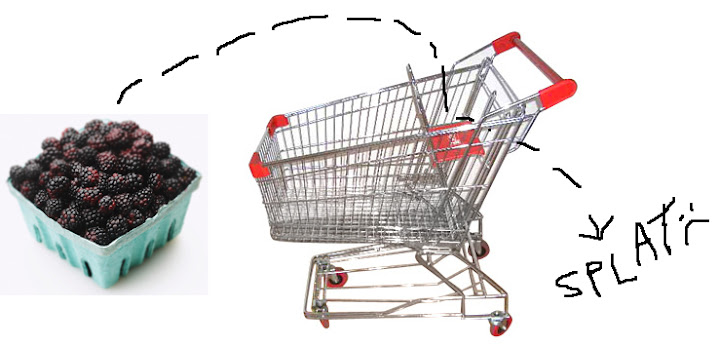
So, feeling particularly inspired by Gustaf’s recent post on "brain food", I decided to buy some antioxidant-laden berries during a recent trip to the food store on Tuesday night. (Yeah, that’s right, I called it a “food store”—do you wanna fight about it?) Anyway, lo and behold, there they were: blackberries, on sale for $1.99. I picked up a carton, sized it up, liked what I saw, and nonchalantly placed it into my grocery cart (into the upper "basket" area by the handle). But alas, it seems my placement was a little too nonchalant as the carton immediately fell out the back of the cart and onto the floor:
Upon impact, the carton popped open, berries flew everywhere, pandemonium ensued. My 1st reaction was to giggle and look around nervously to see if there were any witnesses (there weren't). My 2nd reaction was to realize I had quite the crisis of conscience on my hands. I could...
a) Put a canvas bag over my head and run out of the store with identity concealed and dignity intact.
b) Grab a new container and continue shopping as if the whole thing never happened only to become wracked with guilt a few minutes later when a voice got on the PA to request "cleanup in produce".
c) Go ask the high school kid working at the deli what I should do, and be told: "Screw 'em, man, s*** happens".
d) Get on my knees, put the fallen berries back in the carton, buy them, wash them ridiculously thoroughly with water, and eat them.
Which option do you think I chose? What would you have done?

Monday, February 23, 2009

Feed Your Mind

I'm not quite sure what caused it (that recent brain MRI, undergone for a research study, which revealed an unexpectedly noticeable degree of CSF in my parietal lobe, perhaps?), but I've lately developed an obsession with eating (and cooking) in a brain-friendlier fashion.

My newfound neural neurosis might also stem, in part, from a research article I read not long ago that discussed the profound effects of malnutrition on the human brain. The study, which used MRI to assess the brains of acutely ill anorexia patients both before and after inpatient hospitalization, reported that brain matter actually atrophies in tandem with starvation-induced weight loss. Fortunately, this (and other) research also suggests that the brain can "grow back", at least in part, with proper weight restoration.

Cerebral sustenance
Whereas the above article offers a more drastic example of how food and nutrients (or the lack thereof) can affect the brain, a July 2008 Economist article discusses subtler, yet more universally applicable, evidence of this phenomenon. Titled "Food for thought", the piece offers various tips on how to "eat your way to a better brain", citing many foods known to enhance learning, improve memory, and protect again age-related cognitive decline.

Such foods include those rich in: omega-3 oils (e.g., salmon, kiwi, walnuts); folic acid (spinach, beans); and antioxidants such as Vitamin C (berries, citrus), Vitamin E (almonds, avocado, vegetable oils), and flavanoids (tea, dark chocolate, red wine). For more details, including a "Brain Food" menu for the entire day, check out the Economist article here.